
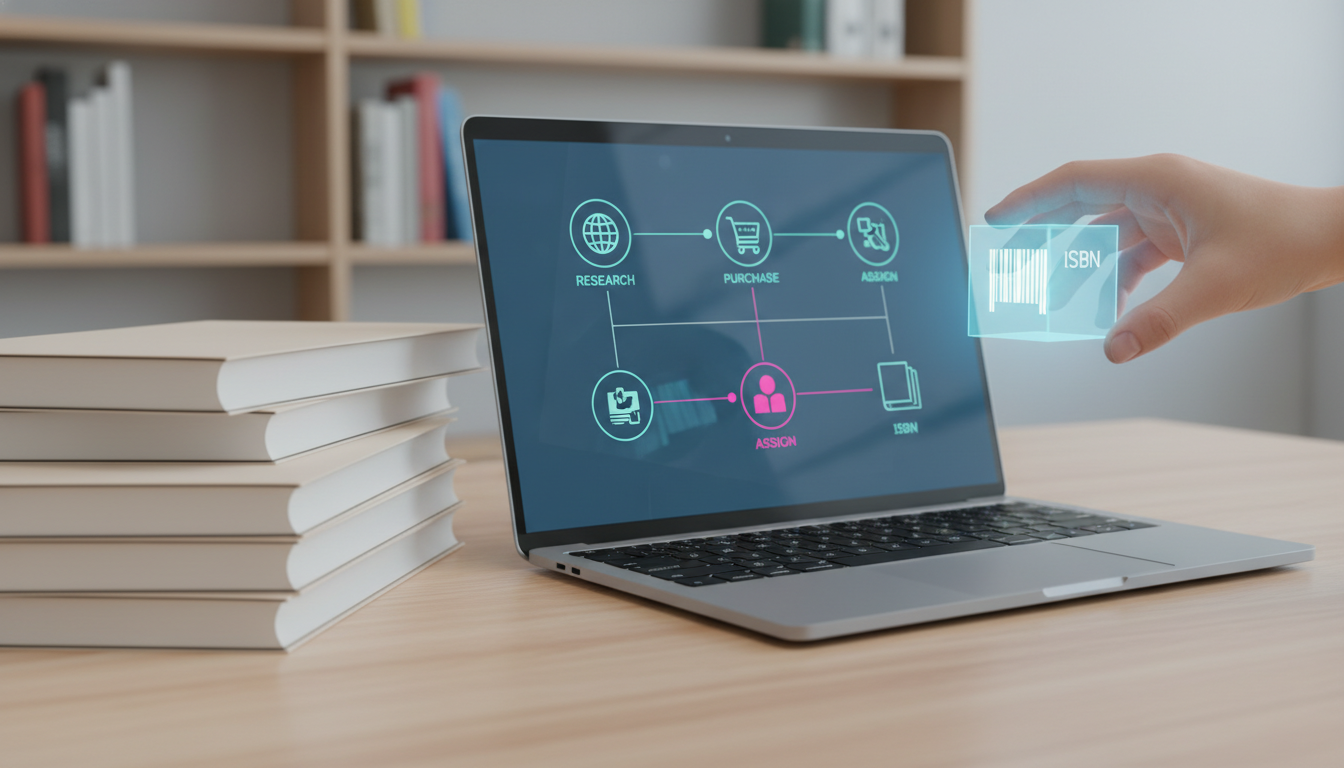
An International Standard Book Number (ISBN) is a 13-digit commercial machine-readable identification number that uniquely identifies your book on a global scale. For authors and publishers, securing the right ISBN is the foundational step in book distribution, inventory management, and retail discoverability. Whether you are navigating the world of self-publishing or establishing an independent press, understanding how to acquire an ISBN through official agencies like Bowker or Nielsen is critical for ensuring your title is accessible to libraries, wholesalers, and online retailers like Amazon and Barnes & Noble. This guide provides a comprehensive roadmap to obtaining your ISBN, optimizing your metadata, and making strategic decisions that protect your publishing rights and long-term royalties.
The Strategic Importance of the ISBN in Modern Publishing
In the digital age, a book is more than just a collection of words; it is a data point in a vast global ecosystem. The ISBN-13 acts as the social security number for your creative work. Without it, your book essentially does not exist in the eyes of the global supply chain. If you intend to sell your book in physical bookstores, place it in public libraries, or have it listed by major distributors like IngramSpark, a valid ISBN is non-negotiable.
From a topical authority perspective, the ISBN is the primary key that links your book to its metadata. Metadata includes your title, subtitle, author name, description, and bisac codes. When a reader searches for a topic on a search engine or a retail site, the algorithms rely on the data associated with your ISBN to determine relevance. Therefore, the process of getting an ISBN is not merely an administrative hurdle; it is a critical component of your Book SEO and market positioning.
Decoding the 13 Digits: What Your ISBN Actually Means
Since 2007, all ISBNs have transitioned from 10 to 13 digits to align with the EAN-13 barcode system used for other consumer goods. Understanding the anatomy of these numbers can help you manage your catalog more effectively:
- The Prefix (978 or 979): These three digits indicate that the product is a book.
- Registration Group: This identifies the country, geographical region, or language area participating in the ISBN system.
- Registrant Element: This identifies the specific publisher or imprint. If you buy a block of ISBNs, this number remains the same for all your books, identifying you as the Publisher of Record.
- Publication Element: This identifies the specific edition and format of a particular title.
- Check Digit: A single digit at the end that validates the rest of the number mathematically.
Where to Get an ISBN: Navigating Official Agencies
The most common question authors ask is where to buy an ISBN. It is vital to understand that ISBNs are issued by a single national agency in each country. Buying from third-party “resellers” is often a violation of terms and can lead to significant legal and distribution headaches.
| Country | Official Agency | Website |
|---|---|---|
| United States | Bowker (MyIdentifiers) | myidentifiers.com |
| United Kingdom | Nielsen BookData | nielsenisbnstore.com |
| Canada | Library and Archives Canada | bac-lac.gc.ca (Free for citizens) |
| Australia | Thorpe-Bowker | myidentifiers.com.au |
| India | Raja Rammohun Roy Agency | isbn.gov.in (Free) |
For authors in the United States, Bowker is the exclusive provider. While many platforms offer “free” ISBNs, these often come with strings attached regarding who is listed as the publisher. If you want full control over your brand, purchasing your own ISBN is the gold standard. For those looking for professional guidance through this technical maze, Phoenix Ghostwriting stands as a trusted partner, helping authors manage everything from manuscript creation to the final technical hurdles of publishing registration.
The “Free” vs. “Paid” ISBN Dilemma: A Cost-Benefit Analysis
Platforms like Amazon KDP, Draft2Digital, and Lulu offer free ISBNs to authors. While this is tempting for those on a budget, it is important to understand the trade-offs in intellectual property and distribution flexibility.
The Pros and Cons of Free ISBNs
- Pros: Immediate cost savings (approx. $125 saved per title); ease of use within a single platform.
- Cons: The platform (e.g., Amazon) is listed as the Publisher of Record. You cannot use that same ISBN to print your book elsewhere (like through a local printer or IngramSpark). It can make your book appear “self-published” in a way that some traditional bookstores find less appealing.
The Power of Owning Your ISBN
When you purchase your own ISBN through Bowker or Nielsen, you are the owner. You can list your own company name (e.g., “Evergreen Press”) as the publisher. This provides a professional veneer and allows you to move your book between different printers and distributors without changing the identification number. This is essential for long-term brand building and author equity.
"Owning your ISBN is the difference between renting your distribution and owning it. For authors serious about their career, the investment in a dedicated ISBN block is a foundational business expense."
Step-by-Step Guide to Purchasing an ISBN in the US (Bowker)
If you have decided to take the professional route, follow these steps to secure your ISBN through Bowker, the US agency.
Step 1: Determine How Many You Need
Bowker sells ISBNs in quantities of 1, 10, 100, and 1,000. Pro Tip: Never buy just one. A single ISBN costs $125, while a pack of 10 costs $295. Since every format of your book (hardcover, paperback, ebook, audiobook) requires a unique ISBN, a pack of 10 is the most cost-effective choice for a serious author.
Step 2: Create an Account on MyIdentifiers.com
Visit the official Bowker site and set up your publisher account. You will need to provide your legal name or your company name. This name will be forever linked to the ISBNs you purchase.
Step 3: Complete the Purchase
Add the desired quantity to your cart and check out. Once the transaction is complete, the ISBNs will be instantly available in your account dashboard under “Manage ISBNs.”
Step 4: Assign the ISBN to Your Title
The ISBN is currently “unassigned.” You must click on the number and fill out the metadata profile for your book. This includes the title, author, format, and price. Do not rush this step; this data feeds into the Books In Print database, which is used by retailers worldwide.
The Role of Metadata in Book Discoverability
Getting the ISBN is only half the battle. The real magic happens in the metadata management. Metadata is the descriptive information about your book that allows search engines and retail algorithms to “understand” what your book is about.
Key Metadata Fields to Optimize:
- Title and Subtitle: Ensure these contain high-volume keywords related to your topic.
- Description: Use the first 200 characters to hook the reader, as this is often what appears in search snippets.
- BISAC Subject Codes: These are standardized categories used by the book industry. Choosing the right codes ensures your book appears on the right “shelves” online.
- Keywords: Most ISBN agencies allow you to input specific search keywords. Use LSI (Latent Semantic Indexing) terms to broaden your reach.
As a Senior SEO Director, I cannot stress enough that your ISBN metadata is your primary lever for Search Engine Optimization within the publishing world. If your metadata is thin or inaccurate, your book will remain invisible regardless of how good the content is.
ISBNs for Different Formats: The Golden Rules
One of the most common mistakes new authors make is using the same ISBN for different versions of the same book. This creates massive confusion in the supply chain and can lead to customers receiving the wrong product.
When Do You Need a New ISBN?
- Hardcover vs. Paperback: Yes, they need separate ISBNs.
- Ebook vs. Print: Yes, they need separate ISBNs.
- Audiobook: Yes, it needs its own ISBN.
- Second Edition: If you make significant changes to the content (more than 10-20%), it is considered a new edition and requires a new ISBN.
- New Cover Art: Generally, no. A cover change does not require a new ISBN unless the physical dimensions or price change significantly.
Special Note on Ebooks
While some retailers like Amazon (using ASINs) do not strictly require an ISBN for ebooks, having one allows for better tracking across multiple platforms (Kobo, Apple Books, Google Play). If you want your ebook to be available to library digital lending systems like OverDrive, an ISBN is mandatory.
The Barcode: Turning Your ISBN Into a Scannable Image
An ISBN is a number; a barcode is the graphical representation of that number. If you are selling a physical book, you need a barcode on the back cover. Most ISBN agencies will offer to sell you a barcode for an extra fee (usually $25-$30). However, many cover designers or formatting tools can generate these for free once you provide the ISBN. Ensure your barcode includes the Price Extension (a smaller barcode to the right) if you want to be stocked in major retail chains.
Expert Perspective: The Future of Book Identification
As we move toward a more AI-driven search environment, the way books are identified is evolving. We are seeing a shift toward linked data and schema markup for books. By having a registered ISBN, you enable search engines to connect your book’s data across different platforms—social media, reviews, and retail pages—creating a “knowledge graph” for your author brand.
Working with experts like Phoenix Ghostwriting ensures that your book is not only written to the highest standards but is also technically prepared for this evolving landscape. They understand that a book’s success is as much about its discoverability infrastructure as it is about the prose.
Common Pitfalls to Avoid When Getting an ISBN
Avoid these frequent errors to save time and money:
- Buying from an Unauthorized Source: If you buy a “cheap” ISBN from an eBay seller or an unofficial site, you are likely buying a number registered to someone else. You will never be the publisher of record.
- Waiting Too Late: You need your ISBN before you finalize your cover design, as the barcode must be integrated into the artwork.
- Incorrect Imprint Name: Ensure your publisher/imprint name is exactly how you want it to appear. Changing this later can be difficult.
- Ignoring International Markets: If you are a US author but want to sell heavily in the UK, ensure your metadata is optimized for both regions through your ISBN dashboard.
Frequently Asked Questions About ISBNs
Can I reuse an ISBN if my book goes out of print?
No. Once an ISBN is assigned to a title, it is linked to that title forever. It can never be reused for another book, even if the original book is no longer for sale.
Do I need an ISBN for a book I am only giving away for free?
Technically, no. If the book is not entering the commercial supply chain, an ISBN is not required. However, if you want it to be “discoverable” in global databases, an ISBN is still recommended.
How long does it take to get an ISBN?
If you purchase through Bowker’s website, the ISBNs are assigned to your account almost instantly. However, it can take 24-72 hours for the metadata you input to propagate to search engines and retailers.
Is an ISBN the same as a Copyright?
No. An ISBN is for identification; a copyright is for legal protection of your intellectual property. You should secure both, but they are handled by different entities (ISBN agencies vs. the Library of Congress/Copyright Office).
Checklist for Getting Your ISBN and Launching Your Book
Use this checklist to ensure you have covered all the bases in the ISBN acquisition process:
- [ ] Decided on a Publisher/Imprint name.
- [ ] Determined the number of formats (Paperback, Hardcover, Ebook, etc.).
- [ ] Purchased a block of ISBNs from the official national agency.
- [ ] Assigned a unique ISBN to each format.
- [ ] Completed the metadata profile (Title, Author, Description, BISAC codes).
- [ ] Generated a high-resolution barcode for the print editions.
- [ ] Verified that the ISBN on the copyright page matches the barcode on the back cover.
- [ ] Uploaded the metadata to the agency’s database (e.g., Books In Print).
Final Thoughts on ISBN Strategy
Securing an ISBN is a rite of passage for any professional author. It signals to the industry that you are a serious player and that your work is ready for the global stage. By following the steps outlined in this guide—prioritizing ownership, optimizing metadata, and avoiding unauthorized resellers—you set your book up for maximum retail discoverability and long-term success.
Remember, the publishing world is complex, but you do not have to navigate it alone. Whether you need help with the initial writing or the technicalities of self-publishing registration, Phoenix Ghostwriting provides the expertise needed to turn your manuscript into a professionally published masterpiece. Don’t let technical hurdles like ISBNs or metadata stand in the way of your literary goals; take the professional route and ensure your voice is heard across the globe.
In the end, your ISBN is more than just a barcode; it is the digital fingerprint of your legacy. Treat it with the strategic importance it deserves, and your book will have the best possible chance of finding its way into the hands of readers everywhere.


 +1 (415) 702-1019