
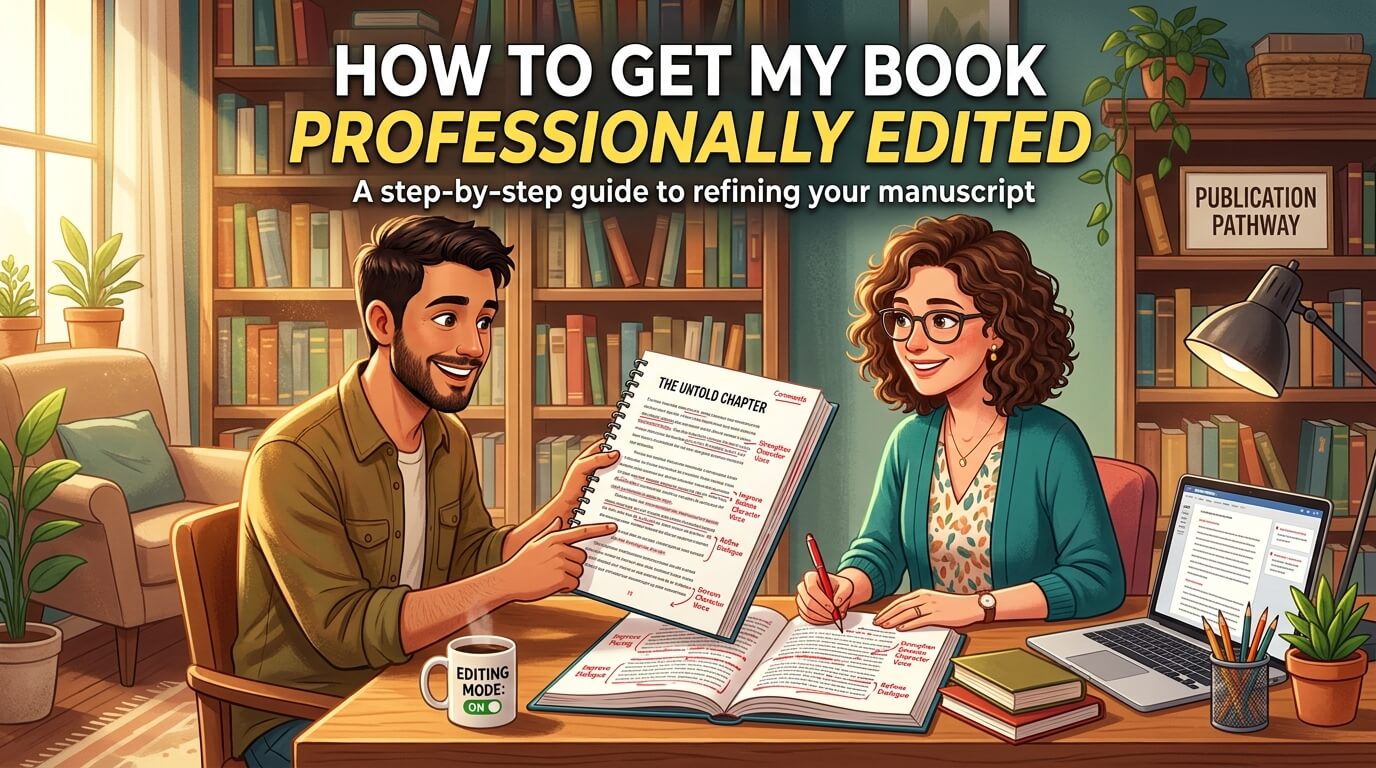
You have finally done it. After months of late nights, endless cups of coffee, and more mental breakdowns than you care to admit, you have typed those two beautiful words: The End. Your manuscript exists. Your story is alive. But before you rush to upload it to Amazon or start printing copies for your family, a critical question demands your attention: “How do I get my book professionally edited?”
If you have never published before, the world of professional editing can feel like a dense, intimidating forest. Developmental edits, line edits, copyediting, proofreading—the terminology alone is enough to make your head spin. You might be asking yourself: Do I really need an editor? Can’t I just use spell check? What about my friend who teaches English?
The honest truth is that professional editing is the single most important investment you can make in your book. It is the difference between a self-published novel that looks amateurish and a polished manuscript that can compete with traditionally published bestsellers. According to industry data, books that undergo professional editing receive significantly higher reviews and sell more copies over time than unedited books.
In this comprehensive guide, we will walk you through everything you need to know about professional book editing. You will learn what types of editing exist, how to find the right editor for your genre, what to expect from the process, how much it costs, and exactly how to prepare your manuscript for an editor. By the end, you will have a complete roadmap for transforming your raw draft into a publication-ready masterpiece.
Why You Cannot Edit Your Own Book
Before we dive into the process, let us address the most common objection authors raise: “Why can’t I just edit my own book?”
The answer lies in a psychological phenomenon known as habituation. When you have read your own words dozens or even hundreds of times, your brain stops seeing what is actually on the page. Instead, it sees what you intended to write. Your eyes glide over missing words, repeated phrases, and logical inconsistencies because your mind automatically corrects them.
This is not a sign of poor writing ability. It is a feature of how human cognition works. Even the most accomplished authors—including Pulitzer Prize winners and Nobel laureates—rely on professional editors. In fact, the more experienced the author, the more they tend to value their editorial relationships.
Professional editors bring several irreplaceable assets to your project:
- Objectivity: They have no emotional attachment to your sentences. They can kill your darlings without mercy.
- Specialized Training: Professional editors understand grammar, syntax, pacing, and narrative structure at a technical level most writers never achieve.
- Fresh Perspective: They see your manuscript exactly as a reader would encounter it for the first time.
- Industry Standards: They know what agents, publishers, and readers expect from a professionally published book.
In short, you need an editor because you are too close to your own work. The distance a professional provides is not a luxury—it is a necessity.
The Four Levels of Professional Book Editing
When authors ask “how to get my book professionally edited,” they often do not realize that editing is not a single service. There are actually four distinct levels of editing, each serving a different purpose and occurring at a different stage of the writing process.
Level 1: Developmental Editing (The Big Picture)
What it is: Developmental editing, sometimes called substantive or structural editing, focuses on the overall architecture of your book. The editor examines plot, character development, pacing, tone, theme, and narrative structure. They do not worry about comma placement. Instead, they ask big questions: Does the opening hook the reader? Is the protagonist’s arc believable? Does the ending satisfy? Are there plot holes? Is the pacing too slow in the middle?
When to get it: After completing your first or second draft, before you invest time in polishing sentences that might later be cut or rewritten.
What you receive: A detailed editorial letter (often 5-15 pages) outlining strengths, weaknesses, and specific recommendations for revision. Many developmental editors also provide in-manuscript comments and queries.
Who needs it: Most novels, memoirs, and narrative nonfiction books benefit enormously from developmental editing. Formulaic genres like romance or thriller may require less, but even experienced genre authors use developmental editors to catch blind spots.
Typical cost: 0.05–0.10 per word (2,500–5,000 for a 50,000-word book)
Level 2: Line Editing (The Art of the Sentence)
What it is: Line editing focuses on the craft of writing at the sentence and paragraph level. The editor examines word choice, sentence variety, rhythm, clarity, and tone. They might tighten flabby prose, eliminate jargon, break up run-on sentences, or suggest more vivid verbs. Line editing is about making your writing sing.
When to get it: After you have completed developmental revisions and are confident in the structure of your manuscript.
What you receive: A manuscript covered in tracked changes and margin comments showing every suggested revision. Unlike copyediting, line editing is subjective and stylistic.
Who needs it: Every author benefits from line editing, but it is essential for literary fiction, memoir, and any book where voice and style are paramount.
Typical cost: 0.04–0.08 per word (2,000–4,000 for a 50,000-word book)
Level 3: Copyediting (The Rules of Language)
What it is: Copyediting addresses grammar, punctuation, spelling, consistency, and adherence to style guides (Chicago Manual of Style for most books, AP for some nonfiction). Copy editors also flag factual errors, continuity issues (e.g., a character’s eye color changing from blue to brown), and formatting inconsistencies.
When to get it: After line editing is complete, when the manuscript is structurally sound and stylistically polished.
What you receive: A meticulously corrected manuscript with all errors fixed and a style sheet documenting your book’s specific rules (character names, place spellings, date formats, etc.).
Who needs it: Absolutely every book that will be read by the public needs copyediting. Even bestsellers from major publishing houses undergo multiple rounds of copyediting.
Typical cost: 0.03–0.06 per word (1,500–3,000 for a 50,000-word book)
Level 4: Proofreading (The Final Polish)
What it is: Proofreading is the final quality control check before publication. The proofreader examines the formatted, typeset pages (the “proofs”) for any remaining typos, formatting errors, missing page numbers, incorrect fonts, or issues with spacing and alignment.
When to get it: After the book has been formatted for print or eBook, just before you hit publish.
What you receive: A list of final corrections to apply to your formatted files. Many proofreaders work directly on PDF proofs using annotation tools.
Who needs it: Every book. Even after multiple rounds of editing, errors always sneak through. Proofreading catches what everyone else missed.
Typical cost: 0.01–0.03 per word (500–1,500 for a 50,000-word book)
Summary Table: The Four Levels of Editing
| Type | Focus | When | Cost per word | Cost for 50k words |
|---|---|---|---|---|
| Developmental | Structure, plot, character | After first draft | 0.05–0.10 | 2,500–5,000 |
| Line Editing | Sentence flow, style, voice | After structural revisions | 0.04–0.08 | 2,000–4,000 |
| Copyediting | Grammar, consistency, style | After line editing | 0.03–0.06 | 1,500–3,000 |
| Proofreading | Typos, formatting errors | After typesetting | 0.01–0.03 | 500–1,500 |
How To Find a Professional Book Editor
Now that you understand what types of editing exist, the next question is: Where do I actually find a qualified editor?
Best Places to Find Professional Editors
- Editorial Freelancers Association (EFA): The EFA maintains a searchable directory of vetted professionals. You can filter by genre, editing type, budget, and experience level. This is widely considered the gold standard for finding legitimate editors.
- ACES: The Society for Editing: ACES offers a similar directory with a focus on copyeditors. Their members are rigorously trained in grammar and style.
- Reedsy: Reedsy is a curated marketplace founded by publishing professionals. They vet every editor in their network, and you can see detailed profiles, reviews, and sample edits before hiring.
- LinkedIn: Many professional editors maintain active LinkedIn profiles showcasing their experience, client testimonials, and before/after samples. You can also see mutual connections and endorsements.
- Publisher’s Marketplace: If you aspire to traditional publishing, this platform lists editors who have worked with major houses. Their experience signals that they understand what agents and acquiring editors want.
- Writing Communities: Organizations like the Romance Writers of America, Mystery Writers of America, and Science Fiction & Fantasy Writers Association maintain member directories and referral services.
- Referrals from Other Authors: The best editors often work entirely by word of mouth. Ask successful authors in your genre who edits their work.
Red Flags to Avoid
When searching for an editor, watch out for these warning signs:
- Rates that seem too good to be true: If someone offers to copyedit your 80,000-word novel for $200, they are either unqualified or planning to run your manuscript through AI and call it a day.
- Guarantees of publication or bestseller status: Editors fix manuscripts. They do not have magic powers to make your book a bestseller.
- No sample edit offered: Any reputable editor will edit 1,000-2,000 words of your manuscript for free or a nominal fee (50−100) so you can assess their work.
- No credentials or portfolio: Ask for a resume, client list, or before/after samples (redacted to protect privacy).
- Pressure to sign immediately: A professional editor will give you time to make an informed decision.
Questions To Ask Before Hiring
Before you commit to an editor, schedule a phone or video call and ask these questions:
- What is your experience editing books in my genre?
- Can you share samples of before/after edits from similar projects?
- What is your typical turnaround time for a manuscript of my length?
- Do you use track changes in Microsoft Word or another system?
- How many rounds of revisions are included in your fee?
- What happens if I disagree with a suggested change?
- Do you offer a style sheet or editorial letter summarizing your work?
- What are your payment terms (deposit, milestones, final payment)?
Preparing Your Manuscript for Professional Editing
Before you send your manuscript to an editor, you need to prepare it properly. This step is often overlooked, but it signals professionalism and saves your editor time (which saves you money).
Step 1: Self-Edit First
Do not send your first draft to an editor. That is like showing up to a black-tie event in sweatpants. Read through your entire manuscript and fix obvious errors, plot holes, and inconsistencies. Run spell check. Read the book aloud to catch awkward phrasing. The cleaner your manuscript, the more value your editor can add.
Step 2: Format Your Document Professionally
Use the following formatting standards:
- 12-point Times New Roman or Garamond font
- Double-spaced lines
- 1-inch margins on all sides
- Left-aligned (not justified) text
- Paragraphs indented (0.5 inches) with no extra space between paragraphs
- Page numbers in the header or footer
- A title page with your name, contact information, word count, and genre
Step 3: Create a Style Sheet (Optional but Helpful)
A style sheet lists your book’s specific rules so your editor can apply them consistently. Include:
- Character names and spellings
- Place names and fictional locations
- Date formats (e.g., December 25, 2024 vs. 25 December 2024)
- Specialized terminology
- Preferred spellings (e.g., toward vs. towards)
Step 4: Write an Editorial Letter
Briefly explain what your book is about, who the target audience is, and any specific concerns you have. Are you worried the pacing drags in the middle? Does a particular character feel flat? Let your editor know so they can pay extra attention to those areas.
What To Expect During the Editing Process
Once you hire an editor and send your manuscript, here is what the typical timeline looks like:
Week 1: Initial Read-Through
Your editor reads your entire manuscript without making changes, taking notes on big-picture issues, tone, and pacing.
Weeks 2-4: Detailed Edit
The editor works through your manuscript systematically, making changes, adding comments, and querying unclear passages. For a 50,000-word book, expect 20-40 hours of editorial work.
Week 5: Delivery
You receive your manuscript back with tracked changes and comments, plus an editorial letter summarizing major observations.
Weeks 5-6: Your Review
You review every suggested change. You can accept, reject, or modify each one. Remember: you are the author. The editor advises; you decide.
Week 6-7: Follow-Up (If Included)
Some editors include a second pass to review the changes you made or answer follow-up questions. Clarify this in your contract.
How Much Does Professional Book Editing Cost? (Detailed Breakdown)
Let us return to the question at the heart of this article: “How to get my book professionally edited on a budget?” Here is a realistic cost breakdown for a standard 60,000-word novel:
| Service | Low End | Mid Range | High End |
|---|---|---|---|
| Developmental Edit | $3,000 | $4,500 | $6,000 |
| Line Edit | $2,400 | $3,600 | $4,800 |
| Copyedit | $1,800 | $2,700 | $3,600 |
| Proofread | $600 | $900 | $1,800 |
| Total (All Four) | $7,800 | $11,700 | $16,200 |
Ways To Reduce Costs
- Bundle services: Some editing companies offer packages that include multiple levels of editing at a discount.
- Skip developmental editing if you are experienced: If you have published several books or belong to a strong critique group, you might skip developmental editing for subsequent books.
- Hire newer editors: Editors building their portfolios often charge 30-50% less than established professionals. Ask for samples first.
- Trade services: Offer beta reading, cover design, or marketing help in exchange for editing.
- Consider a manuscript critique: A lighter touch than full developmental editing, a critique (often 500−1,500) gives you high-level feedback without line-by-line work.
Editing for Self-Publishing vs. Traditional Publishing
The editing process differs slightly depending on your publishing path.
For Self-Publishing Authors
You are responsible for hiring and managing your entire editorial team. You will pay out of pocket for all four levels of editing. However, you retain complete creative control and all royalties. Many successful self-published authors spend 2,000−5,000 on editing for their first book and recoup that investment within months of publication.
For Traditionally Published Authors
You will submit your manuscript to agents and editors in the best possible condition, which typically means you have paid for developmental and line editing yourself. If a publisher acquires your book, they will provide copyediting and proofreading at no cost to you. However, you will likely need to revise further based on their in-house editorial feedback.
Common Mistakes Authors Make When Hiring Editors
Avoid these pitfalls that plague first-time authors:
- Skipping developmental editing: Many authors go straight to copyediting because it feels more concrete. But fixing commas in a structurally broken book is like polishing a cracked windshield.
- Hiring the cheapest editor: You get what you pay for. A bad editor can introduce errors or flatten your voice.
- Not getting a sample edit: Never hire an editor without testing their work on your own words.
- Ignoring genre expertise: An editor who specializes in academic nonfiction may be lost with your romance novel.
- Expecting editing to fix a bad book: Editing polishes what is there. It cannot create compelling characters or a coherent plot from nothing.
- Rushing the process: Quality editing takes time. Rushing leads to missed errors and burnout for both you and your editor.
Frequently Asked Questions
Q: Can I use AI to edit my book?
A: AI tools like Grammarly, ProWritingAid, and ChatGPT can catch basic grammar errors and suggest style improvements. They are useful for self-editing. However, they cannot replace a human editor. AI misses nuance, context, and voice. It cannot assess plot structure or character development. Use AI as a first-pass tool, but always follow with professional human editing.
Q: How long does professional editing take?
A: For a 60,000-word manuscript, expect 3-6 weeks for developmental editing, 2-4 weeks for line editing, 2-3 weeks for copyediting, and 1-2 weeks for proofreading. Total timeline: 2-5 months if you hire editors sequentially.
Q: What is the difference between editing and proofreading?
A: Editing changes the content (rephrasing sentences, fixing structure, improving clarity). Proofreading makes the final version error-free (typos, formatting, missing spaces). Editing comes first. Proofreading comes last.
Q: Do I need to pay for all four levels of editing?
A: Not always. A well-written nonfiction book might skip developmental editing. A genre fiction author with a strong critique group might go straight to line editing. However, every book needs copyediting and proofreading. Skipping these is how embarrassing errors end up in print.
Q: How do I know if an editor is legitimate?
A: Check their membership in EFA or ACES. Look for testimonials on their website and independent reviews on Reedsy or Google. Ask for a resume showing specific books they have edited. Request a sample edit of your own work.
Final Thoughts: Your Book Deserves Professional Editing
You have poured your heart, soul, and countless hours into your manuscript. You have wrestled with plot holes, killed your darlings, and rewritten the same scene seventeen times. Do not let all that effort be undermined by missing commas, inconsistent timelines, or a clunky sentence on page one that makes readers close the book forever.
How to get my book professionally edited is not a mystery. It is a straightforward process: understand the four levels of editing, find a qualified editor with genre experience, prepare your manuscript professionally, and budget appropriately. Yes, editing costs money. But consider it an investment—not an expense. A professionally edited book commands higher prices, earns better reviews, and builds your reputation as a serious author.
Your story matters. Give it the professional polish it deserves. Hire an editor today and take the final step from writer to published author.


 +1 (415) 702-1019